

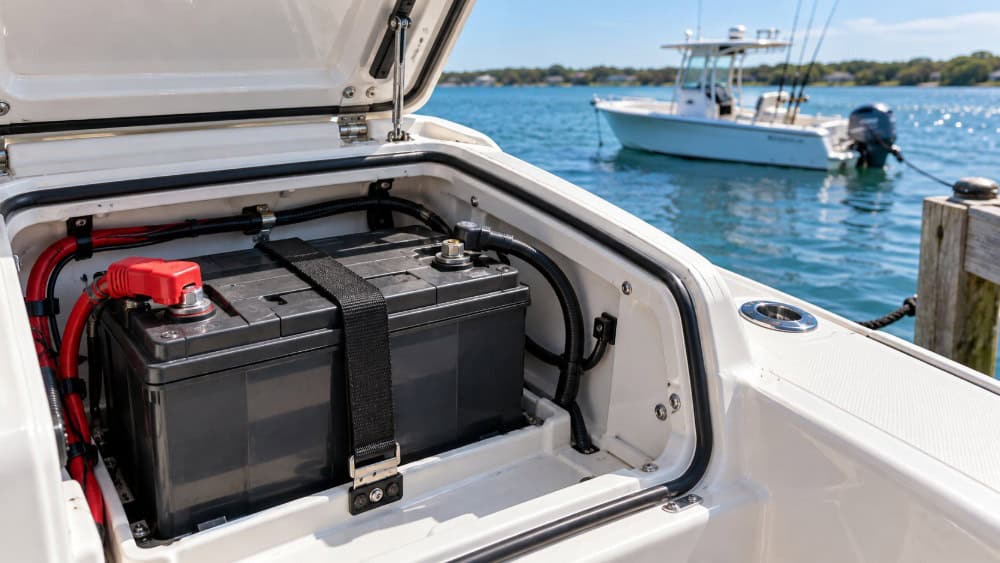
Choosing the right marine battery comes down to matching the type to your boat and how you use it: starting batteries crank the engine with short, high-current bursts, deep-cycle batteries power your electronics for several hours, and dual-purpose batteries handle a bit of both.
Maritime NZ’s 2023–2025 recreational boating survey found that 4% of respondents experienced engine or power failure during their latest boating trip, so getting this choice right matters.
This guide covers every decision point, from battery types and amp hours to MCA ratings and winter storage.
Can You Use a Car Battery in Your Boat?
A car battery isn’t built for marine conditions and shouldn’t be used in a boat.
Car batteries are designed to deliver a quick, high-current burst to start an engine, and the charging system begins replenishing the energy used for starting once the engine is running.
On a boat, the battery needs to handle hours of steady draw from fish finders, GPS units, lights, and bilge pumps while also coping with constant vibration from waves.
Marine batteries are constructed differently to handle this kind of punishment.
In conventional lead-acid designs, the internal plates are thicker and bonded to the battery case, which reduces the risk of cracking or shifting when the boat bounces through choppy water.
Car batteries don’t have this reinforcement, so their plates are more likely to warp and lose contact under the repeated jolts of being on the water.
R&J Batteries NZ notes that using a car battery in a marine setting leads to reduced service life, risks plate cracking and distortion, and may void the warranty.
A car battery might technically start an outboard, but it won’t hold up to the sustained loads and physical demands that marine use requires.
What Are the Three Types of Marine Batteries?
Marine batteries fall into three main categories: starting, deep cycle, and dual purpose, and each one is designed for a different job on board.
Picking the right type is the single most important decision when choosing a marine battery.
How Does a Starting Battery Work?
A starting battery delivers a short, powerful burst of current to crank the engine.
In conventional lead-acid designs, it uses more, thinner plates inside the case, which increases the surface area and allows the battery to push out high amps quickly.
Once the engine is running, the charging system begins replenishing the energy used for starting.
Starting batteries aren’t designed to be deeply discharged, so they shouldn’t be used to power accessories for extended periods.
What Does a Deep Cycle Battery Do?
A deep cycle battery provides steady, reliable power over several hours and is designed to be discharged and recharged hundreds of times.
In conventional lead-acid designs, it uses fewer, thicker plates that handle repeated cycling without breaking down.
For longer service life, size a lead-acid deep cycle battery around a routine discharge of approximately 50%, unless the manufacturer specifies otherwise.
LiFePO4 deep cycle batteries generally allow a greater usable share of their rated capacity than lead-acid batteries, which means you get more usable power from the same amp hour rating.
Follow the manufacturer’s recommended discharge limit, as over-discharge can still damage lithium batteries.
Deep cycle batteries are the right choice for running electronics, fridges, trolling motors, and lights when the boat is anchored or at low speed.
When Does a Dual Purpose Battery Make Sense?
A dual purpose battery is a compromise that handles both engine starting and moderate accessory loads in one unit.
Cranking power is generally lower than a dedicated starting battery, and cycle life is typically shorter than a dedicated deep cycle battery.
They’re best suited to smaller trailer boats with limited space and modest electrical demands.
If a boat has heavy draw from multiple accessories, a dual purpose battery is likely to have a shorter lifespan than a setup with two separate batteries.
| Feature | Starting | Deep Cycle | Dual Purpose |
|---|---|---|---|
| Primary use | Engine cranking | Powering accessories | Both |
| Plate design (lead-acid) | Many thin plates | Fewer thick plates | Mid-weight plates |
| Discharge style | Short high-current burst | Steady draw over hours | Moderate both |
| Best for | Dedicated engine-starting duties | Fishing boats, yachts, boats at anchor with gear running | Small trailer boats with limited space |
| Key rating to check | MCA or CCA | Amp hours (Ah) | Both MCA and Ah |
| Suited to deep cycling | No | Yes | Moderate |
How Many Amp Hours Do You Need for Your Boat?
The right amp hour (Ah) rating depends on the total power draw of your on-board electronics and how long you need them to run between charges.
Amp hours measure a battery’s total capacity: a 100 Ah battery rated at the 20-hour rate can theoretically deliver 5 amps for 20 hours.
Actual runtime depends on the discharge rate, temperature, battery condition, and permitted depth of discharge.
When planning around the recommended 50% discharge for lead-acid batteries, a 100 Ah lead-acid deep cycle battery gives you roughly 50 Ah of usable power within that allowance.
Lithium batteries generally provide a greater share of their rated capacity, delivering more usable energy for a given weight.
To work out what you need, add up the amp draw of each piece of equipment on your boat and multiply by the number of hours you’ll use it.
A fish finder typically draws 1 to 2 amps depending on the model, a full set of LED navigation lights well under 1 amp, a VHF radio about 1 amp on receive and up to 5 amps when transmitting, and a fridge between 3 and 5 amps while the compressor is running, though it cycles on and off so daily consumption is lower.
For a day trip with moderate electronics, many trailer boats find 80 to 120 Ah of deep cycle capacity sufficient as a starting point.
Larger boats with fridges, multiple screens, and electric winches will typically need more capacity.
Size the house battery based on your equipment’s expected consumption between charges, the battery’s permitted depth of discharge, and a reserve allowance.
Reserve capacity (RC) is another spec worth checking.
RC measures how many minutes a fully charged 12V battery can supply 25 amps at 26.7°C before the voltage drops below 10.5 volts, which gives you a safety margin if the charging system fails while you’re out on the water.
What Is MCA on a Battery?
MCA stands for marine cranking amps, and it measures how much current a starting battery can deliver for 30 seconds at 0 degrees Celsius while keeping the voltage at or above 7.2 volts.
It’s the marine-specific version of cold cranking amps (CCA), which runs the same test but at minus 18 degrees Celsius.
Because batteries perform better in warmer conditions, the MCA figure for any given battery will always be higher than its CCA figure.
The general rule of thumb is that MCA is roughly 20 to 25 percent higher than CCA, so you can estimate CCA by multiplying MCA by 0.8.
A battery rated at 1,000 MCA, for example, would deliver roughly 800 CCA.
This matters when you’re comparing batteries or matching one to your engine manufacturer’s minimum cranking requirement, which is often listed as CCA in the owner’s manual.
Check your outboard or inboard engine manual for the minimum cranking amps required, the test standard used, and any additional capacity or battery-type requirements, then make sure the battery you choose meets or exceeds those specifications.
How Long Does a Marine Battery Last?
Most marine batteries last between three and five years with proper use and maintenance, according to Discover Boating.
The actual lifespan depends on the battery chemistry, how often it’s cycled, how it’s charged, and how well it’s looked after between trips.
Flooded lead-acid batteries are the most affordable option but require regular maintenance in serviceable models, including topping up electrolyte levels and cleaning terminals.
With good care, they typically last three to four years.
AGM (absorbent glass mat) batteries are sealed and don’t require watering, though they still need regular charging, terminal, and mounting checks.
They generally last four to six years and charge faster than flooded batteries, but they’re sensitive to overcharging, which can shorten their life.
Lithium iron phosphate (LiFePO4) batteries often offer substantially longer cycle life, with many rated for eight to ten years or 2,000-plus charge cycles under the manufacturer’s specified conditions.
They’re lighter, provide more usable capacity, and handle deeper discharges than lead-acid batteries, but they cost more upfront.
The most common signs that a marine battery needs investigating are slow engine cranking, the battery not holding a charge between trips, visible swelling or leaking from the case, and noticeably reduced run time on your electronics.
These symptoms warrant testing the battery, charging system, and connections before deciding on a replacement.
Do You Need a Dual Battery Setup or Will a Dual Purpose Battery Work?
A dual-purpose battery is likely to handle the demands of small trailer boats with minimal electronics, such as a fish finder and navigation lights.
If your boat runs multiple accessories like a live bait tank, stereo, LED light bars, or a trolling motor, a dedicated dual battery setup will give you far better performance and reliability.
A dual battery system uses two separate batteries: one starting battery to crank the engine and one deep cycle “house” battery to power your accessories.
This setup reduces the risk of your accessories draining the battery you need to start the engine.
The two batteries are commonly connected through a voltage-sensitive relay (VSR) or a DC-DC charger.
A VSR is the simpler and more affordable option, automatically linking the batteries when voltage thresholds are met so the charging system can charge both, including the alternator.
A DC-DC charger provides a regulated charge to the house battery, which is better for AGM and lithium batteries that need specific charge profiles.
For boats with heavy electrical demands, a dual battery system is worth the investment.
It’s likely to extend the life of both batteries because each one is used for the job it’s designed for, rather than asking a single battery to do everything.
How Should You Store Your Marine Battery Over Winter?
The best way to store a lead-acid marine battery over winter is to fully charge it, disconnect the terminals, and keep it in a cool, dry place with a compatible smart maintenance charger connected.
A lead-acid battery that sits in a partially discharged state for weeks or months will develop sulphation, where lead sulphate crystals harden on the plates and permanently reduce the battery’s capacity.
Before storing your battery, charge it to 100% using a compatible charger.
Disconnect the negative terminal first, then the positive, to prevent any parasitic drain from onboard electronics.
Keep in mind that disconnecting the battery also disables any equipment powered by it, including automatic bilge pumps, so make sure this is appropriate for your storage arrangement.
If possible, remove the battery from the boat entirely and store it in a location that stays above freezing.
A smart maintenance charger (also called a float charger) is the single best investment for extending lead-acid battery life over winter.
These chargers monitor the battery’s voltage and deliver a small charge only when needed, keeping the battery at full capacity without overcharging.
Don’t confuse a smart maintenance charger with an unregulated trickle charger, which can overcharge a battery if left connected for extended periods.
If you don’t have a maintenance charger, check the battery voltage every four to six weeks during storage.
A fully charged, rested 12V lead-acid battery should read around 12.6 to 12.8 volts with the charger and loads disconnected.
If the voltage drops below 12.4V, recharge it promptly to prevent sulphation from setting in.
For serviceable flooded lead-acid batteries, check the electrolyte levels before storage, ensure the plates are covered, and top up with distilled water after charging if any cells are low.
For lithium (LiFePO4) batteries, follow the manufacturer’s storage instructions, as they typically don’t require a maintenance charger and have different state-of-charge recommendations for long-term storage.
Need Help Choosing the Right Marine Battery?
Picking the right marine battery comes down to matching the battery type, capacity, and chemistry to the way you use your boat.
Get the sizing right and look after the battery properly, and it’ll give you years of reliable service on the water.
As a marine battery supplier and installer in Auckland, Eurosparx can help you choose the right battery for your boat, install it correctly, and set up dual battery systems if needed.
Contact our team today by calling 09 218 7789 to discuss your marine battery needs.
Frequently Asked Questions
Can I use a car battery in my boat?
You can physically fit a car battery in a boat, but it isn’t designed for the marine environment. Car batteries lack the vibration resistance and construction that marine batteries are built for. A car battery used as a house battery will fail quickly because it can’t handle repeated deep discharges. Always use a purpose-built marine battery for safety and longevity.
What is the difference between a starting and deep cycle marine battery?
A starting battery delivers a short, high-current burst to crank the engine, then the charging system replenishes that energy once the engine is running. A deep cycle battery provides steady, lower-level power over a long period to run accessories like fish finders and lights. Starting batteries use thin plates for quick energy release, while deep cycle batteries use thicker plates designed for repeated discharge and recharge cycles.
How many amp hours do I need for my boat?
The amp hours you need depend on what electronics you’re running and for how long. Add up the amp draw of each device and multiply by hours of use. Many trailer boats with a fish finder, nav lights, and a bilge pump find 80 to 120 amp hours sufficient. For lead-acid batteries, double the total to account for the recommended 50% discharge allowance.
What does MCA mean on a marine battery?
MCA stands for marine cranking amps and measures how much current a battery can deliver at 0°C for 30 seconds while staying above 7.2 volts. It’s the marine equivalent of CCA (cold cranking amps), which is tested at the colder temperature of minus 18°C. MCA ratings are roughly 20 to 25 percent higher than CCA for the same battery, so always compare like for like.
How long does a marine battery last?
Most marine batteries last between three and five years with proper care. Flooded lead-acid batteries typically last three to four years, AGM batteries four to six years, and lithium iron phosphate batteries eight to ten years under the manufacturer’s specified conditions. The main factors that shorten battery life are deep discharging, leaving a battery in a partially charged state, overcharging, and exposure to extreme heat. Correct charging and maintenance extend lifespan.
What’s the difference between AGM and lithium marine batteries?
AGM batteries are sealed, don’t require watering, and are more affordable upfront, lasting four to six years. Lithium iron phosphate batteries cost more but last eight to ten years, weigh roughly half as much, and generally provide a greater share of their rated capacity. Lithium also charges faster and handles deeper discharges, making it a strong long-term option for heavy-use boats when correctly specified.
Do I need a dual battery system on my boat?
A dual battery system is likely worth it if your boat has multiple accessories drawing power while the engine is off. A single dual purpose battery suits boats with just navigation lights and a fish finder. Once you add a live bait tank, stereo, or trolling motor, separate starting and house batteries reduce the risk of draining the battery you need to start the engine.
How do I maintain my marine battery during winter storage?
For lead-acid batteries, fully charge before storage, disconnect the terminals (negative first), and store in a cool, dry place above freezing. Connect a smart maintenance charger to keep the battery topped up without overcharging. If you don’t have a maintenance charger, check the voltage every four to six weeks and recharge if it drops below 12.4 volts. For lithium batteries, follow the manufacturer’s specific storage instructions.